
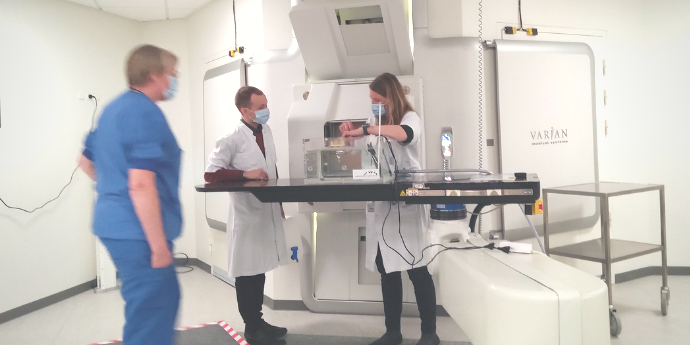
Tumours and normal tissue respond differently to the same dose when delivered with protons or x-rays. This differential radiobiology can be exploited and used to further optimise the clinical use of proton therapy. A range of different physics parameters, such as linear energy transfer (LET) and dose rate, will be investigated for the impact on biological response. This includes a large scale study of normal tissue effects in in vivo models to establish the influence of increased LET on the RBE, Relative Biological Effectiveness. Another current project is on experimental verification of the biological effects of FLASH therapy, where the radiation dose is delivered at ultra-high dose rates about 1,000 times faster than in conventional radiotherapy.
The expected outcome of the radiobiology research will be a largely improved understanding of the biological response of radiation and the interaction with cancer and healthy tissues for the future design of optimal cancer treatments. This is an international focus area with high scientific impact and with obvious clinical perspectives.
The radiobiology research at DCPT is linked to the national research centre DCCC Radiotherapy (WP10, National Infrastructure For Experimental Radiation Oncology) and European Particle Therapy Network (EPTN) (WP6, RBE and radiobiology), and collaborating with Technical University of Denmark - DTU, Biotech Research & Innovation Centre (BRIC) – University of Copenhagen, Varian Medical Systems and University of Oslo.
 Novo Nordisk Foundation Professor of experimental particle therapy and radiobiology
 Postdoc
 Postdoc
 Professor of medical physics
 Novo Nordisk Foundation Professor of experimental particle therapy